The Pipette Doesn't Do Maths: A Kitchen-Table Calibration Check for CBD Drops
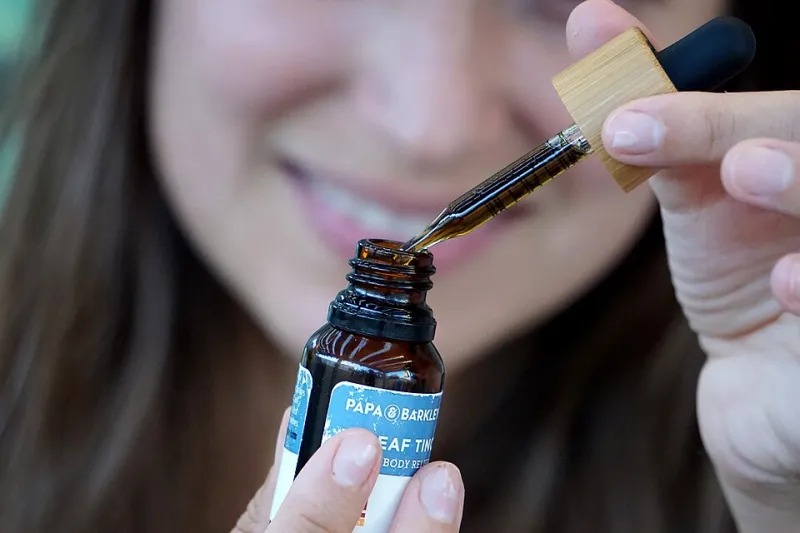
Photo: elsaolofsson, CC BY 2.0, via Wikimedia Commons
Open a CBD oil box and you'll often see a friendly little instruction: 'Take 20 drops.' Open the bottle and you'll find a pipette covered in tiny lines. The two don't always agree. A drop is not a fixed unit; it's an event created by gravity, viscosity, the tip of the pipette and how hard you squeeze. In 2026, UK shoppers have more CBD bottles than ever, and most still come with a dropper that expects you to do a small amount of maths.
That's not a scandal. It's just physics in a small glass tube. But if you're trying to keep your dose steady, it helps to know whether your 'twenty drops' is closer to half a millilitre or a full one. This is a kitchen-table check, not a laboratory exercise. No lab coat required.
Why your twenty drops aren't my twenty drops
Drop size changes with the oil. A thin, light oil flows quickly and tends to form smaller drops. A thicker, darker oil can form fatter ones. Temperature matters too: a bottle kept by a cold window will behave differently from one at room temperature. So does the pipette tip — a narrow tip makes smaller drops, a wider one makes bigger drops. And then there's technique. Squeeze gently and you get one size; squeeze hard and you get a squirt, not a drop.
This is why two people with the same bottle can end up with different doses. One person's twenty drops might be 0.8ml. Another person's might be 1.2ml. If the oil is 100mg per ml, that's the difference between 80mg and 120mg — a 40mg gap created by nothing more than a pipette and a heavy hand.
What the mg per ml label actually tells you
The most useful number on a CBD oil label is not the total milligrams. It's the milligrams per millilitre. You get it by dividing the total CBD by the bottle size. A 10ml bottle with 1000mg is 100mg per ml. A 10ml bottle with 500mg is 50mg per ml. A 30ml bottle with 1500mg is also 50mg per ml.
Once you know that, the graduation marks on the pipette become useful. If your oil is 100mg per ml, then 0.5ml is 50mg and 0.25ml is 25mg. If your oil is 50mg per ml, then 0.5ml is 25mg. You don't need to count drops at all. You just need to know where the lines are.
The '20 drops equals 1ml' rule is a convention, not a law. It assumes a standard dropper, a standard liquid and a standard squeeze. Your bottle may not have signed up to that convention.
The kitchen-table calibration check
This is the simple version. It takes about five minutes and one clean glass.
-
Check the marks on your pipette. Many 1ml pipettes have lines at 0.25ml, 0.5ml, 0.75ml and 1ml. If yours has no useful marks, buy a 1ml oral syringe from a pharmacy. They are cheap, and they take the guesswork out of the whole thing.
-
Fill the pipette to the 0.5ml line. Wipe the outside with kitchen roll so you're not counting drips that were already on the glass. Hold it vertically over a clean glass.
-
Squeeze gently and count each drop until the liquid level reaches the 0.25ml line. Go slowly. You want drops, not a stream. Write down the number.
-
Repeat the process twice with fresh oil in a clean glass. Don't put oil back into the bottle — once it has left the pipette, it stays out.
-
Average your three counts. That gives you the number of drops in 0.25ml. Multiply by four and you have drops per millilitre. If your counts were 6, 7 and 6, the average is about 6.3, so roughly 25 drops per ml. If they were 4, 8 and 5, your technique is inconsistent; slow down and try again.
You can practise with water first if you don't want to spend oil. Just remember that water drops are not oil drops. Use the water run to learn where the lines are, then do the oil run for the number that matters.
When counting drops is perfectly fine
Counting drops is not wrong. It's fine when you're using the same bottle, the same pipette and the same technique every time. It's fine if you've done the calibration once and you're not changing anything. It's fine for a rough starting point, especially with a lower-strength oil where a few drops either way won't make much difference.
It's also fine if the label gives you a drop-based serving and you're sticking to it. The trouble starts when you switch bottles, switch brands, or try to compare your dose with someone else's.
When to reach for the millilitre marks instead
Use the graduation marks when you're opening a new bottle, especially from a different brand. Use them when you're changing your dose, sharing a bottle with someone else, or trying to keep a steady record. Use them with high-strength oils, where a small difference in volume is a bigger difference in milligrams. Use them if you're sensitive to changes, or if you're taking CBD alongside medication and want to keep things as consistent as possible.
If you're ever unsure, a 1ml oral syringe is the least dramatic upgrade you can make. It measures volume directly, it's easy to clean, and it removes the whole drop-count debate from your morning routine.
The label still rules
None of this is a reason to ignore the label. In the UK, CBD oil is sold as a food supplement, not a licensed medicine. Follow the maximum daily amount on the pack, keep the bottle out of reach of children and pets, and talk to your GP or pharmacist if you're pregnant, breastfeeding, taking prescription medicines or dealing with liver problems. If you feel unwell after taking CBD, stop and seek advice.
Calibration is just about knowing what you're actually taking. It's a small bit of kitchen admin that makes the rest of the routine less fuzzy. At CBD First Online, we'd rather you spent two minutes with a pipette and a glass than a fortnight wondering why your usual twenty drops felt different from a new bottle's twenty drops.
The short version
A drop is not a reliable unit. A millilitre is. Check your pipette's marks, work out the mg per ml, and calibrate once in a while. If you like counting drops, carry on — but know what your drops are worth.